Rail Enhancements Hierarchy
Where a railway already exists, improvements can often be made to the train service without the need for expensive new infrastructure. The purpose of this page is to help sponsors of projects aiming to improve the service on an existing railway to work through a range of options for achieving this that do not involve new infrastructure.
Where a rail link already exists, there may be a need to improve the train service for the following reasons:
- Increase capacity to alleviate overcorwding on existing trains
- Increase the frequency of service to reduce the time that passengers have to wait for a train
- Reduce the journey time to existing destinations
- Introduce new direct services to additional destinations to enhance journey opportunities
Where rail service enhancements are needed, there can often be a temptation to immediately resort to planning new or upgraded infrastructure. However, other enhancements to the railway system could deliver train service improvements more quickly and cost-effectively. There may be limitations on the existing infrastructure which prevent the aspired trains service being fully delivered without investment, but it is important to fully investigate what is possible within those limitations. The investigation may identify alternative ways of delivering the sponsor’s aspirations (e.g. longer trains to deliver capacity enhancement instead of more frequent trains). Even if the outcome of the investigation is that enhanced services cannot be delivered without infrastructure, important evidence and understanding will have been gained as to the nature of the limitations and potential solutions, which will strengthen the case for investment.
The Railway as a System
The following video describes how the whole railway works as a system. It is important to understand this before trying to work out what needs to change in order to facilitate the required improvements.
Better Value Rail Video – the railway as a system
What options should be considered before infrastructure?
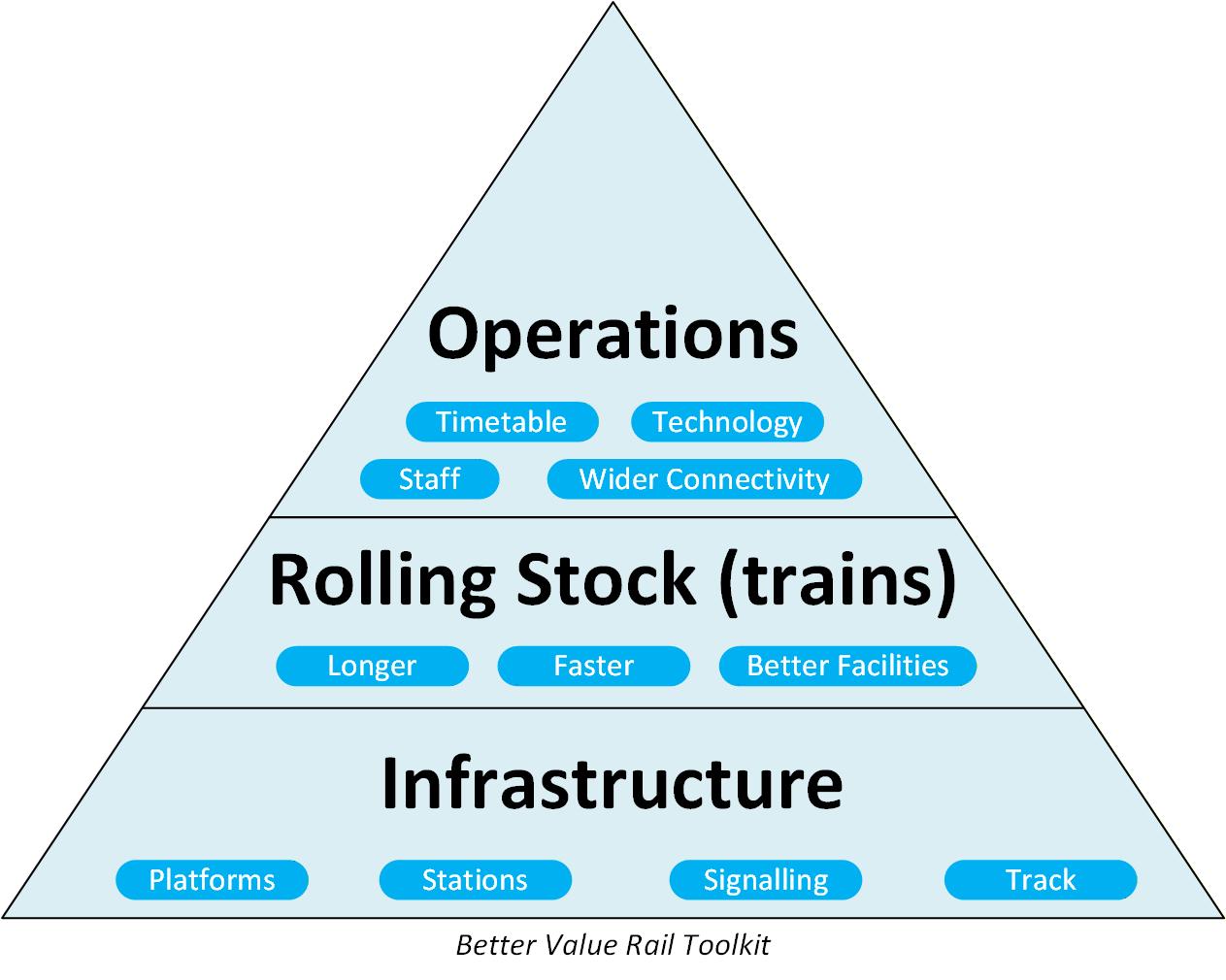
The diagram below shows the ‘Hierarchy of Rail Enhancements’, the preferred order that rail enhancements should be considered in. The triangle shape represents the increasing cost, complexity and delivery timescale that will be encountered the further down the hierarchy the option is.
Safety and Risk
No matter what option is considered, even if no new or modified infrastructure or rolling stock is being introduced, any changes can impact or introduce new risks. These risks need to be assessed.
For example, changing the train service that operates on a section of railway could result in a significant increase in the number of trains. This will have a knock on impact on operational complexity, human factors, workforce pressures, infrastructure stress and potential interface risks such as level crossings. Therefore an assessment will need to be carried out by the Train Operating Company (TOC) and Network Rail to ensure that risk levels are not increased and remain at acceptable levels. Under safety legislation, specifically the Railways and Other Guided Transport Systems (Safety) Regulations 2006 (known in the industry as ‘ROGS’) and the Health and Safety at Work Act 1974, both the TOC and Network Rail (as the infrastructure manager) share responsibility for ensuring that any changes or ongoing operations do not increase risk beyond what is considered “as low as reasonably practicable” (ALARP).
New, upgraded or renewed railway subsystems including rolling stock and infrastructure are also subject to The Railways (Interoperability) Regulations 2011 (known as RIR). Rail safety law requires entities making significant changes to the railway to apply the Common Safety Method for Risk Evaluation and Assessment, an in all cases to identify hazards and control risk as far as reasonably practicable.
An example of a risk that needs to be considered is level crossings. Increasing the frequency of trains that cross a level crossing will increase the probability of a collision wiht a road vehicle or pedestrian. The Railway Industry has clear processes for assessing level crossing risks and clear thresholds for when a risk is considered ‘acceptable’. It is possible that, even if other factors remain the same, increasing the frequency of trains could push the risk level at certain level crossings above the ‘acceptable’ threshold, resuslting in the need to employ additional mitigations. Such mitigations could include upgrading the crossing (for example adding miniature lights to a footpath crossing) or replacing it completely with a bridge.
It is important to understand early in the project if such measures will be required so that the costs and timescales to implement them can be included in the budget and project plan, rather than appearing as an unexpected cost pressure later. More information on these subjects can be found on the ORR website:
Level 1: Operations
Changes to the railway system that deliver benefits while making use of the existing rolling stock and infrastructure offer the best value for money and can be delivered quickest. These changes sometimes require trade-offs – some users/places may benefit at the expense of others – the cumulative impact of the change on all users should be assessed before the option is taken forward.
Changes at this level include:
Factors to consider:
Adding new trains and extending existing trains is only possible if there is spare capacity on the track, junctions and stations. Network Rail will need to carry out a timetable study study to check if this is the case. If there is insufficient capacity for the preferred option, a trade-off in the timetable, such as changing the stopping patterns and timings of trains (see case study below) may facilitate more efficient use of the railway and allow all the required trains to be accommodated. This may mean that certain deliverables, such as journey time or service frequency at certain stations, have to be compromised. This could be worthwhile if it avoids expensive enhancements to the infrastructure, which should only be considered if all operational options have been exhausted.
Adding new trains and extending existing trains will result in more rolling stock needing to be in service. It may be that the train operator can cover this with higher utilisation of its existing fleet, for example using spare trains or by more efficient planning (reducing the time trains spend idle or running empty). Train operators employ experts in rolling stock diagramming who should be consulted in the early stages of optioneering in order to understand the rolling stock position and what changes might be possible. If all the operator’s rolling stock is already highly utilised and the proposed change does not result in more efficient use, additional rolling stock will need to be acquired (see level 2 below). Leasing and maintaining rolling stock is one of the biggest costs of operating a train service, so train service options which make most efficient use of the rolling stock should be prioritised.
Just as increasing the train service results in a greater requirement for rolling stock, it also means more staff (such as drivers, guards and cleaners) will be needed. While the cost of staff is less than the cost of rolling stock, it still represents a significant part of the operational cost of running a railway and the cost of additional staff must be taken into account when comparing options which increase the overall level of service with those that don’t. The ‘cost’ of staff is not just their salary but also covers the need to provide training, management and cover from when they are away from work. As well as the cost, it is important to consider that staff training can take significant time to complete and this needs to be factored into the project implementation plan.
When a train reaches the end of its journey, it will dwell in the station for a time before starting a new journey in the opposite direction. This time is known as the ‘turnaround’ and the length of time that is appropriate will depend on the location and type of service. Minimum times are defined in Network Rail’s Timetable Planning Rules. Operators will normally allow more time than the minimum to allow recovery from delays, but allowing too long reduces rolling stock utilisation and increases platform occupation, potentially leading to there not being enough platforms at terminus stations.
Adding stops to a train’s journey, leading to it reaching its destination later, could mean that the available turnaround time before the train begins its next journey falls below the minimum. That would lead to the timetable needing to be rewritten to allow for longer turnaround times but with more rolling stock covering the same number of journeys. This will result in a high cost and lead time for a change that, on the face of it, seems to be a cheap and simple change to the train service.
All passengers want the highest possible frequency of trains at their local station and the fastest possible journey time to their destination. Every station stop that a train makes increases the time that it takes to get to its destination, usually by several minutes. Adding a station stop to an existing train’s schedule will benefit the users of that station by giving them an extra journey opportunity but will disbenefit other passengers on the train by delaying their arrival at their destination. It is important to consider the total impact on all of the passengers when deciding whether adding or removing a station stop to/from an existing train’s schedule is justified. The case study below illustrates this further.
If a change to the train service will result in a significant number of extra passengers using the stations along the route, an assessment will need to be made as to whether the facilities at these stations can cope with the number of people expected. Features that need to be considered include the width of staircases, the size and number of lifts, the number of toilets, the size of waiting rooms, the number of ticket barriers (if provided) and ticket purchasing facilities.
Case Study: The effect of stopping pattern on journey time and capacity
The tabs in the diagram below illustrate types of stopping pattern that can be deployed on a route, giving different levels of benefit to different stations, and dsicuss the drawbacks of each option. It is important to consider these issues from a ‘whole railway system’ point of view when deciding which trains should stop at which stations.
Example Route
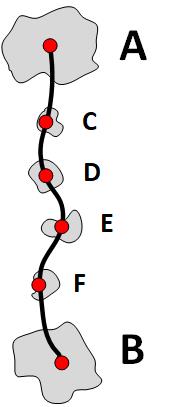
A railway runs between two large cities, A and B. In between them are four smaller towns, C, D, E and F, which each have a station on the railway. It is a two-track railway (one in each direction) with no opportunities for trains to overtake each other. The following rows show possible train service patterns that could be deployed on this route, along with the advantages and disadvantages of each.
Metro
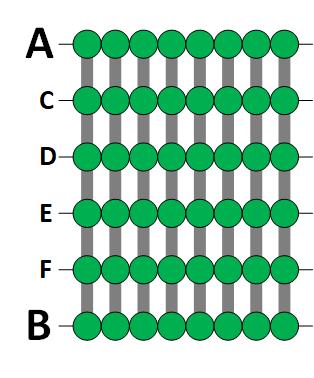
The simplest and most obvious service pattern is to have every train between A and B stopping at all stations in between. This maximises connectivity, providing the highest possible frequency at all the stations and journey opportunities between different stations. As all the trains are travelling at the same speed, the capacity of the route is maximised. However it means there are no fast trains so the journey time between A and B is much longer than it could be. This is a major disadvantage if a high proportion of the passengers on the route are travelling directly from A to B.
Fast/Slow trains
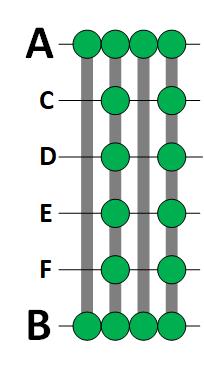
Some trains run non-stop between A and B offering a fast journey time between these stations, others call at intermediate stations provding local connectivity. On the face of it this appears to provide the best of both worlds, however the number of trains that can run on the route is severely limited by the big gaps that must be left between fast and slow trains to avoid the fast trains getting stuck behind slow trains. As a result this service pattern offers lower total capacity than the others, well below the potential capacity of the route, and should only be considered if the number of passengers can be accommodated on this few trains.
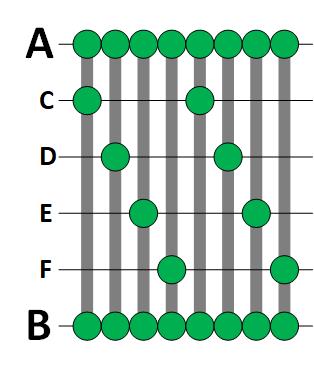
Skip Stop
All the trains travelling between A and B stop at one of the intermediate stations. As a result, the journey time from A to B is only slightly longer than for a non-stop train, each intermediate station gets a reasonable service to both A and B and the capacity of the route is maximised. However, there are no direct trains between intermediate stations – passengers travelling from, say, C to D will need to travel via A, leading to a much longer and more inconvenient journey.
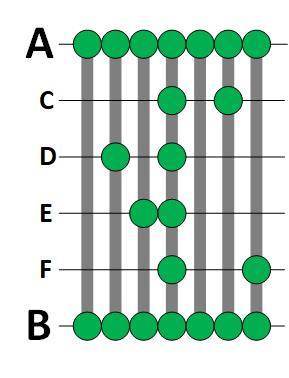
Mixture
As all of the previously introduced stopping patterns have at least one significant drawback, sometimes a complex mixture of all of these is used to achieve a balance of benefits. In the pattern shown, there are two fast trains to achieve headline journey times between A and B, one slow train to facilitate local journeys, and four semi-fast trains which ensure each intermediate station gains a second train per hour but a competitive journey time from A to B is still achieved. Stopping patterns like this are often used on the busiest main lines. The complex nature of the resulting timetable means that any small change, even just adding one more station stop, can mean the whole timetable has to be rewritten.
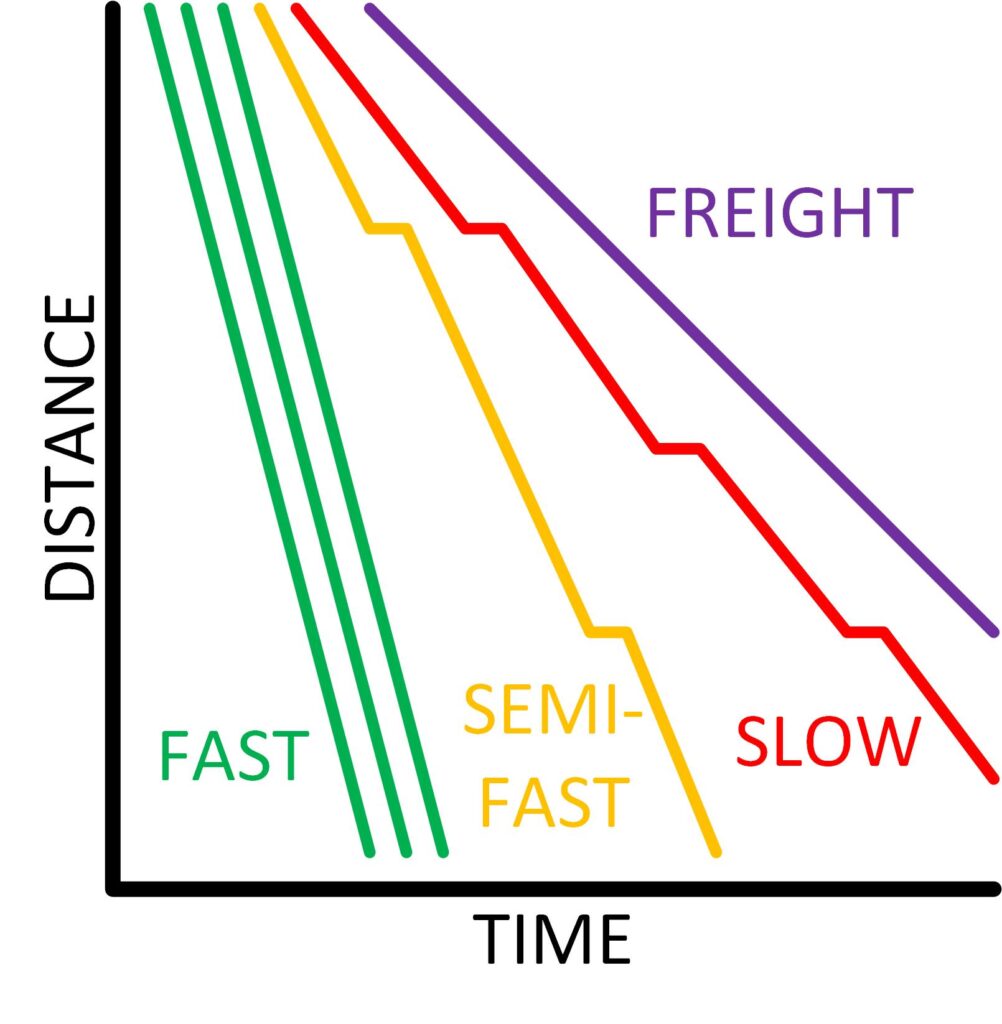
Flighting
When a mixed stopping pattern is employed on a busy main line, train planners will often use a technique known as ‘flighting’ to try and accommodate as many trains as possible. This involves trains that have a similar speed or stopping pattern being grouped together, with the fastest trains running first, followed by semi-fast, then slow trains and freight. There then follows a gap before the next ‘flight’ begins. This pattern makes best use of available track capacity but prevents a regular service interval. For example, it may mean that all of the fast trains between two stations leave close together followed by a large gap. Evening these out through the hour would improve passenger experience but would allow fewer trains to be accommodated.
Why is this important when considering a new rail project?
Some railway lines operate well below their maximum capacity and service changes, such as adding more trains or changing the stopping pattern of existng trains, can be accommodated with limited negative consequences. Other lines operate at or close to their maximum capacity and changes to the service may only be possible by making compromises which will cause significant negative consequences for some users. It is important to consider the timetable at an early stage of any rail project, and ideally consult with Network Rail, in order to understand what constraints exist on the railway in question. This will avoid significant work being undertaken on a service proposal which is clearly not feasible, and may idenify alternatives which have a greater chance of success.
The Timetable process
The following video describes in more detail the process for amending the timetable, including who is responsible for what, and the expected timescales to make a change. For more information see Network Rail’s pages on The Timetable.
Better Value Rail Video – Changing the timetable
Wider Connectivity Improvements
Journeys do not begin and end at the railway station. When deciding if and how to travel, passengers will consider the whole of their journey from origin to destination, including the ‘first and last mile’, not just from station platform to station platform. Improvements to journey time and passenger experience can often most cost effectively be made around the station area. These improvements could include:
Active Travel England have published guidance on how facilities can be improved to encourage rail passengers to cycle to and from stations.
Level 2: Rolling Stock
Certain transport problems, such as overcrowding, can sometimes be solved more cost effectively by deploying different rolling stock rather than upgrading the infrastructure.
Increase capacity by running longer trains
Increasing the length of the rolling stock – i.e. in simple terms adding more carriages to each train – allows more passengers to be carried on a route without running any additional services. This is normally the lowest cost way of alleviating overcrowding. In most cases, as the majority of the space on the track is taken up by the space required to be left between trains rather than the trains themselves. So replacing a short train for a longer one does not impact the capacity of the track and junctions and will not require a change in the timetable.
Reduce journey time by running faster trains
It may be possible to reduce the journey time between stations by obtaining trains that have a higher top speed. This opportunity only exists in a minority of cases as in most places the maximum speed that a train can run is governed by limitations of the infrastructure rather than rolling stock.
For journeys that have a lot of station stops, a significant reduction in journey time can sometimes be gained by using trains that have better acceleration. Switching from diesel to electric traction often has this effect. Traditionally this was only possible if the whole of the train’s route was equipped with electrification, but with the emergence of battery technology, it is becoming possible on unelectrified routes. Electric traction also has the benefits of reduced noise, reduced maintenance and zero emissions.
Any reduction in journey time can only be facilitated by means of a change in the timetable. On routes that have an intensive service or complex service pattern, there may be other factors which hinder journey time improvements. Similarly, though, improving a particular train’s journey time may reduce conflicts and actually improve the capacity or performance of the railway. Network Rail should be consulted early in a project so that the likely impacts can be understood.
Improve accessibility and passenger experience by providing trains with better facilities
Rolling stock with better accessibility features, such as wider doors and gangways and lower floors, can broaden access to the train service and improve the travel experience for everyone with mobility needs, not just disabled people but also those with small children and heavy luggage. Improving the ease with which these people can board trains can also reduce station dwell times – on routes with frequent stops, this can have a significant impact on overall journey time.
Better on-board facilities, such as improved seating with laptop-friendly tables, power supplies for charging devices, and Wifi, can improve passenger satisfaction at a lower cost than enhancements to the train service itself. These facilities can often be added to existing rolling stock during refurbishment or overhaul.
Platform Length
Under normal circumstances, every station platform that a train stops at must be at least as long as the train itself in order to avoid doors on the train opening beyond the end of the platform. If trains on a route are being lengthened, Network Rail will need to check that all of the platforms are already sufficiently long or whether they too need to be lengthened. If there are any specific platforms which it is impossible or exceptionally difficult to lengthen, for example due to buildings or track in the way, it may be possible to implement an arrangement known as ‘Selective Door Operation’ which allows a long train to stop at a short platform by automatically locking doors on the train which are beyond the end of the platform. This arrangement has a number of disadvantages, is dependent on the type of train being used and is not always possible at every location due to infrastructure features.
New Trains?
Nearly all rolling stock on the mainline railway is owned by leasing companies and leased by the train operators. If the operator does not already have sufficient spare rolling stock, they will need to lease more. This, along with additional maintenance and fuel/electricity, will result in an increase in operating costs which must be funded and factored in to the business case. Obtaining brand new rolling stock is particularly expensive, and even once a contract is signed, it will likely take several years before the trains can enter service. Options sometimes exist to take up spare rolling stock from another operator (a process known as ‘cascading’), which is likely to be available sooner and at lower cost. However the trains are obtained, consideration will need to be given to where they will be stored and maintained – a bigger fleet could trigger the need to upgrade the operator’s maintenance facilities.
The following video explains in more detail the issues around changing the rolling stock on a route.
Better Value Rail Video – Changing the rolling stock
Level 3: Change the Infrastructure
If the required train service improvements cannot be delivered by means of the other options, an enhancement to the infrastructure is likely to be required. The Better Value Rail Toolkit will help you decide what infrastructure is required and set up your project in a way that gives the best chance of success. The next step is to work through the Early Stage Specification Process.