Early Stage Specification Process
Step 1: Requirements and Service Outputs
The first step is to ascertain Railway Service Outputs – a set of requirements to convey the service you want to deliver.
The desired outcomes should have been determined using the Strategic Context Checklist and the Strategic Narrative Template – it is important that these tools are revisited as part of an iterative process to ensure your proposal is as strong as possible.
A list of requirements must be created with robust evidence, such as demand modelling, market studies, local plans, government policy, revenue forecasts, to justify the need for change. Start with simple requirements. For example, do you require more frequent trains, more seats, direct trains or shorter journey times? Each of these requirements has a cost and value – does the implementation of this change provide value for money?
At this stage, understanding the value of the requirements is vital. This will allow you to create effective Concept Solutions to meet those goals and avoid wasting significant amount of time chasing unviable approaches.
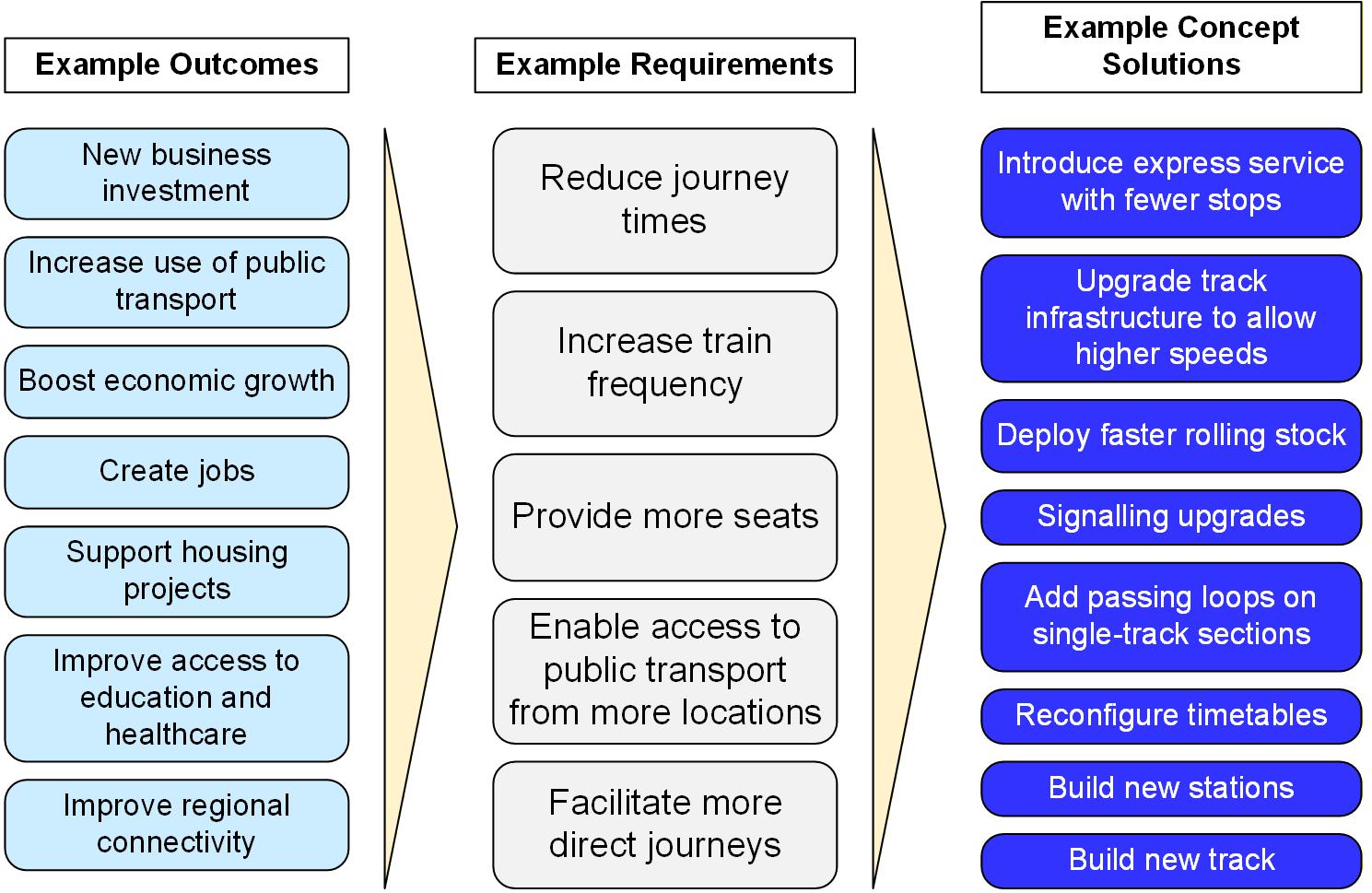
Concept Solutions are early-stage ideas or proposals that outline how to meet the Railway Service Requirements that you have identified. The Concept Solutions are not final designs, but possible ways to achieve your Requirements and thereby your desired outcomes.
When developing the Requirements and Concept Solutions, consider the following:
1
What are you trying to achieve?
Define the strategic objective and the specific change you want to see. Your concept solution should directly respond to this goal.
2
Translate strategic outcomes into railway output
Convert goals into tangible outcomes for passengers. For example, a strategic goal may be to improve regional connectivity. The output of this could be to introduce two additional peak services between Sheffield and Leeds.
3
Assess the value of benefits
Are the benefits of your solutions likely to be worth the cost of implementing? Who benefits, what kind of benefits are on offer, and how significant are they?
4
Consider affordability
Even at this early stage, consider whether your Concept Solutions are financially realistic. What are the likely operational costs? What are the funding sources or constraints? Is the solution scalable or could it be phased? This will help avoid developing ideas that are undeliverable in practics.
When developing the Concept Solutions, various assumptions and risks will inevitably arise and the significance of these will change over time. The Concept Solutions need to be tested against the key assumptions and risks to ensure your proposals are robust and adaptable.
Work through each assumption in the Assumptions Assessment and Significance Tool, record your understanding and schedule when you will revisit each assumption to keep track of the risk, cost or opportunity that may develop. This will: