Early Stage Specification Process
Step 2: Indicative Train Service Specification
Once the Concept Solutions have been developed, the next step is to create an Indicative Train Service Specification (ITSS).
An ITSS is a draft outline of the train services that a proposed project aims to deliver. It translates the strategic goals and service requirements (from Step 1) into a service plan that can inform timetable development and infrastructure decisions.
What does an ITSS include?
- Routes
- Stopping patterns
- Service frequency
- Journey times
- Rolling stock – either exact train types (if known) or generic characteristics (e.g. 4 car electric)
What does an ITSS not include?
Arrival and departure times for each train – it is not a timetable, but the information can go forward to form the basis of an indicative hourly timetable at a later stage.
Why is the ITSS important?
- Supports early modelling of capacity and demand to assess viability.
- Allows for comparison with alternative transport options.
- Highlights what infrastructure investment may be needed.
- Provides a reference case for economic, environmental and social appraisal under Transport Appraisal Guidance (TAG).
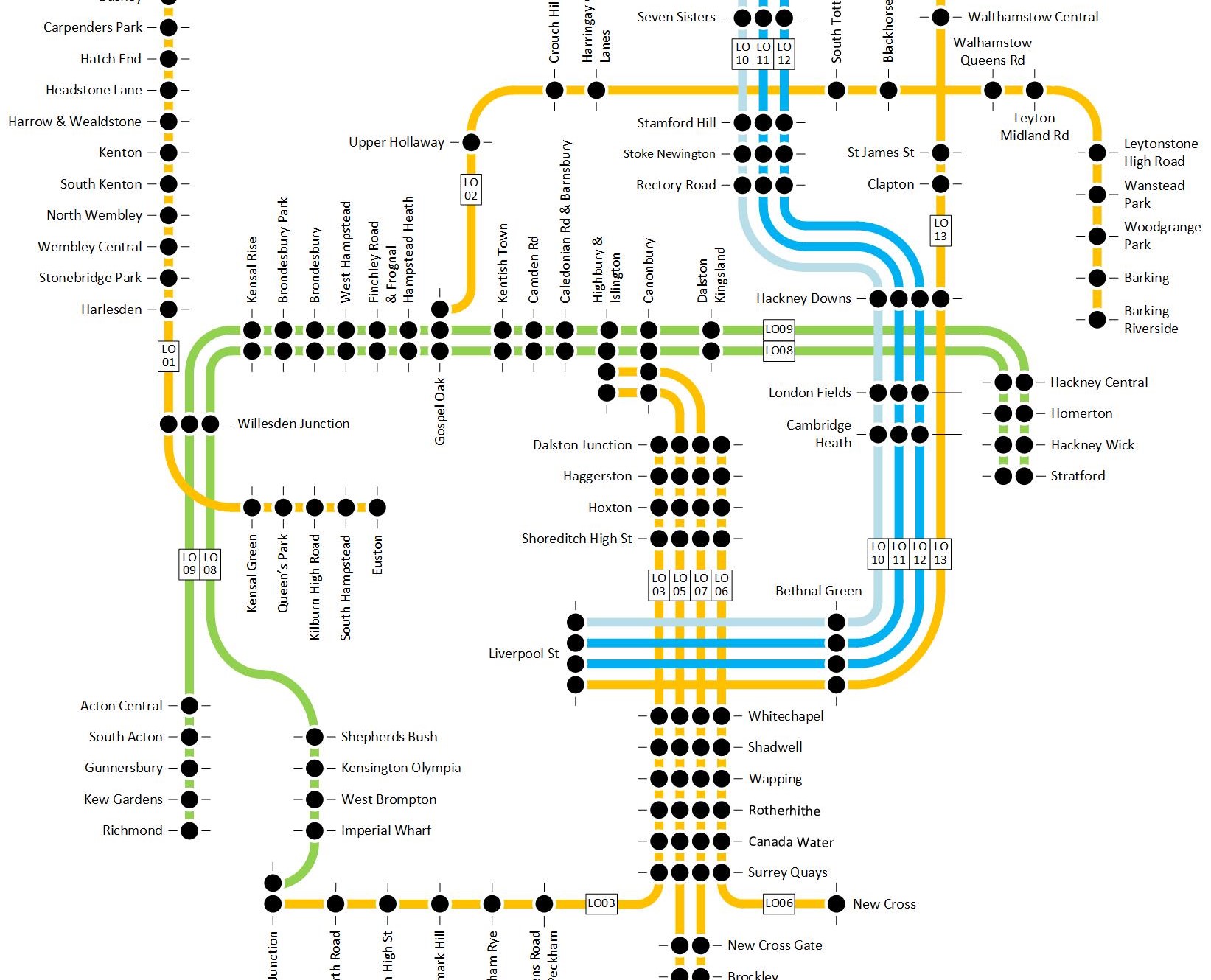
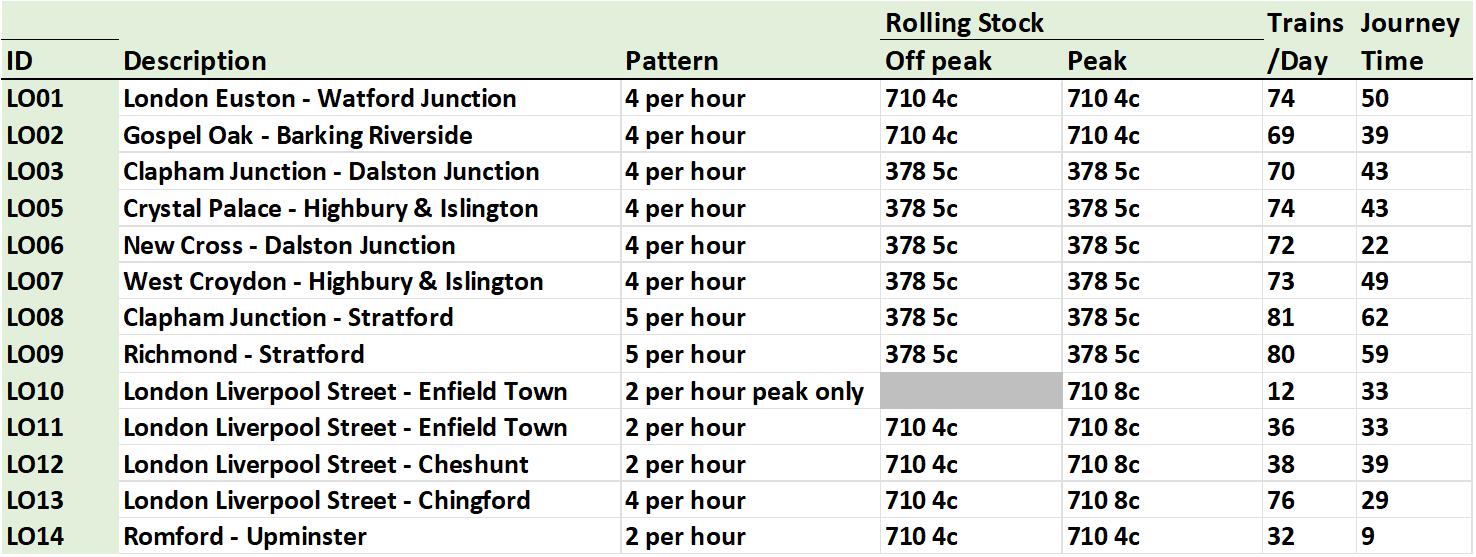
Above is an example ITSS representing the current service operating on London Overground, with trains listed in table form and routes and stopping patterns shown graphically. The information can be shown in different formats depending on the size and complexity of the service being represented.
The Importance of the Baseline
If the project is for a stand-alone transport link unconnected to any existing network, the ITSS should be developed from scratch – i.e. the baseline is zero.
If the project interfaces with the mainline railway or any existing network, it is vital to define the ‘Do Minimum’ baseline – the service that is assumed to be operating on those networks immediately prior to the project’s outputs being delivered – i.e. the service that would continue to operate indefinitely if the project did not exist. This may simply be the service that operates today, or it may need to take into account forthcoming service changes and enhancements being delivered by other projects. The ITSS is developed from the baseline, not from scratch. All proposed changes are modelled against this baseline to highlight what improvements are being made, what remains unchanged and when these changes will be implemented.
Key Considerations
- The ITSS is not a final timetable or a binding requirement; instead it provides a reference case used to guide infrastructure decisions and assess feasibility.
- Until the service detailed in the ITSS has been modelled through capacity analysis (see Step 3), it is not known how well it will perform or whether it is even feasible on the assumed infrastructure.
- As such, the ITSS must remain flexible and open to revision. It is very likely to require iteration as the scale and impact of early versions are better understood and as evidence of feasibility evolve.
- If capacity modelling shows that the aspired train service cannot be accommodated on the assumed infrastructure, amending the ITSS to make compromises to certain features of the train service may be more pallatable to funders than increasing the budget to further enhance the infrastructure.
- There are always trade-offs between frequency of service, train length and seating capacity. These factors must be tested using demand modelling to ensure the service is both viable and valuable.
- The ITSS is not operator-specific. Ther services could be delivered by a number of different operators. Rail Reform and the creation of Great British Railways is likely to mean changes to the organisation of operators so assumptions about who will operate specific services should be avoided.